
Fifty Years of Friendship — A Weekend We’ll Never Forget (But It’s Okay If We Do)
A Reflection on Friendship Center’s 50th Snniversary by Kathryn Westland, Executive Director of Friendship Center
Photography by Evokra Visuals
Posted on Friendship Center’s Blog: https://friendshipcentersb.org/fifty-years-of-friendship-a-weekend-well-never-forget-but-its-okay-if-we-do/
I will buy a McConnell’s ice cream for anyone who thinks they have no connection to Friendship Center and I can’t prove them wrong. Seriously.
If you live in South Santa Barbara County and you think you have no connection to Friendship Center, yes you do. Your neighbors? One of them probably has someone in their life who attended Friendship Center. Your coworkers? Same. Your pharmacist? They almost certainly serve someone who attends Friendship Center. Maybe your neighbor’s husband came here years ago. Maybe your friend was finally able to keep working because her mother spent her weekdays with us. Maybe someone you know sat in one of our caregiver support groups, volunteered here, served on our Board, drove a parent through our gates every morning, or simply found us at one of the hardest moments of their life.
And yet, after 50 years, I still regularly meet people who have lived here for decades or their whole lives who say, “Friendship Center? What is that?”
I don’t say that with disappointment. If anything, it makes me even more proud of what has quietly and unwaveringly happened here since 1976.
For five decades, tucked away beneath a canopy of trees that only Santa Barbara could grow, Friendship Center has quietly been doing deeply important work for thousands of local families. These families have trusted us with life’s most important gifts: the people they love. People living with dementia have spent their days here making friends, singing, creating, laughing, moving, eating together and continuing to be part of a community. Their spouses and children have gone to work, raised their own children, rested, gone to appointments, and simply had a few hours when they knew someone they loved was safe and loved, too…
This year, Friendship Center turned 50!
And after the weekend we just had, I don’t think we can call this “quiet work” anymore.
Three days that somehow captured 50 years:
Our 50th Anniversary Weekend began Friday, September 25, with a reception welcoming the speakers and sponsors of our inaugural Dementia Care Conference, along with our Board and Conference Advisory Committee.
It was so exciting for us to watch people meet one another who, on paper, occupy very different corners of the dementia world.
And a quick note on that word, because “dementia” itself is often misunderstood: dementia is not one specific disease. It is an umbrella term for changes in memory, thinking, behavior or other abilities that become significant enough to interfere with daily life. Alzheimer’s disease is one cause of dementia, but there are many others, including Lewy body dementia, vascular dementia and frontotemporal dementia (FTD).
And sometimes, especially looking back, families realize there may have been signs long before anyone had a name for them. Maybe your aunt was always the one who “did that strange thing,” or Grandpa’s personality seemed to change as he got older, or someone became increasingly confused and everyone simply called it aging. Not every change is dementia, of course, but part of becoming a dementia-informed community is knowing enough to notice when something may deserve a closer look.
Rachael Martinez and Maria Kent Beers, the women behind the Remember Me podcast and foundation, became advocates after both experienced FTD, as daughters and sandwich-generation caregivers. They have taken something enormously difficult and created a community where families can talk about this disease honestly and feel less alone.
In that same room was Dr. Jennifer Yokoyama of UCSF, one of the field’s leading researchers working to understand the genetics and biological mechanisms behind neurodegenerative diseases, including FTD.
Seeing these worlds come together felt beyond cool: the daughters telling families, “We see you. We’ve lived this too,” and the scientist working to understand why these diseases happen and what we may someday be able to do about them.
The next morning, more than 100 people joined us at The Leta Hotel for our first Dementia Care Conference.
We created two tracks, one for family caregivers and one for professionals, with 10 sessions throughout the day, an opening address and a closing multidisciplinary panel. Our 14 speakers came from Santa Barbara and across the country and represented research, neurology, geriatrics, pharmacy, psychology, caregiver advocacy, residential care, elder law, end-of-life care and, importantly, lived experience.
We talked about everything from medications and dementia-related behaviors to aging in place, caregiver resilience, family history, genetics and risk.
But some of the most special moments weren’t on the agenda.
At one point, I met a gentleman who told me he was just beginning this journey. He really didn’t know what he was supposed to do next. And I got to do one of my favorite things: say, “I know just who you need to meet,” and lead him to people he really did need to meet.
I walked him over and introduced him to two of our support group facilitators, Joe Wheatley and Jeffrey Krutzsch. Within minutes, they were talking about other people in our support groups who were at a similar point in their journey. Contact info was exchanged. I don’t know what happens next in his story, but I do know this: he has people now.
Our goal: For Santa Barbara to become even better at dementia care
We collected data before, during, and after the conference because we didn’t want this to be an event where everyone simply had a nice day, ate a nice lunch and went home. We wanted to know whether people actually left better equipped than when they arrived.
They did.
Approximately 90% of respondents rated their learning and anticipated ability to apply what they learned at a four on a five-point scale. But one of my favorite themes in the feedback was much less academic: People left knowing they are not alone.
I was thrilled by the number of family caregivers who came. I was also reminded of how much opportunity remains to bring more of our local professional community into this conversation.
Dementia doesn’t belong to one profession. It walks into doctors’ offices, hospitals, home-care agencies, senior living communities, attorneys’ offices, financial institutions, and nonprofits. There is no single professional pathway that guarantees someone serving an older adult has been adequately prepared to understand dementia.
Next year, I hope we see even more professionals from across our community in the room. Not because Friendship Center has all the answers. We don’t. But after 50 years dedicated to this population, we have learned a great deal, we have lived a great deal, and we have a responsibility to share what we know.
As more organizations expand their dementia-related services, I hope they see Friendship Center as a resource, a partner, and a place to learn. Ultimately, I want someone who leaves Friendship Center and enters another part of our community to find the same understanding there, too.
I want Santa Barbara to be a community that knows how to care for people living with dementia.
Sunday’s triangle bell: homecoming!
The next morning on Sunday, more than 200 people gathered at the Carousel House at Chase
Palm Park for our first Friendship Center Family Reunion.
The San Marcos Royals cheer squad welcomed people as they arrived, which was particularly special for the families who had former San Marcos teachers attend FC, such as Jim Wankum and John McCafferty. The Peer Pressure Band played, followed by FC favorite DJ Darla Bea. We ate sandwiches and McConnell’s ice cream, used goofy props in the photo booth and took rides in the Cycling Without Age Trishaw (cheers, Lee!).
Inside the Carousel House, we created an archive walk through 50 years of Friendship Center history. There were photographs, memories and old newspaper stories documenting pieces of this organization from long before many of us currently carrying its story forward ever arrived.
With all of that fanfare going on, the most special part of the day was seeing our people. I spoke to two daughters whose mom began attending FC in the early 2000s and others whose grandparents attended in the 1980s!
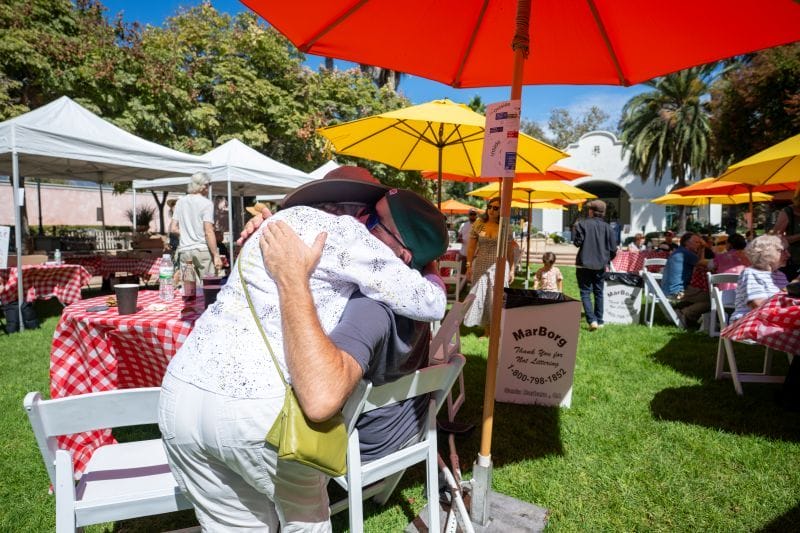
Being graceful with my hugs is something I have never exactly been known for, but, as you can imagine, reconnecting with people over a place that, despite being part of it at completely different times, holds a shared level of importance brought out a lot of beautiful emotions. Tear-soaked shoulders were aplenty around Chase Palm Park that day.
Of course, 50 years gives you an enormous history, but it also gives you an enormous family.
Friendship Center’s history isn’t really the history of a building or a program.
It is thousands of individual stories.
It’s the person living with dementia who came here and was known for who they actually were, not just for their diagnosis. A person who could laugh, contribute, make choices, have friends and simply be themselves. It’s the husband who got a few hours to breathe. It’s the daughter who could keep her job. It’s the staff member who remembers someone 30+ years later. It’s the family that doesn’t need us anymore but still considers themselves part of us.
Friendship Center shouldn’t be Santa Barbara’s best-kept secret anymore
There is so much we are proud of in this community. We preserve our history, celebrate institutions that have shaped Santa Barbara, protect beloved places and traditions. We even know which trees are special!
I think we should be proud that Friendship Center is here, too. Not because we need recognition for recognition’s sake, but because when a family suddenly needs us, they should already know our name. You know who to call when there’s a fire. You know where to go when you break a bone. When dementia enters your family, you should know where to turn, too.
When someone receives a diagnosis, their family shouldn’t have to stumble across Friendship Center months or years later and say, “How did I not know this existed?”.
And when professionals encounter someone living with dementia, I want them to know there is a 50-year-old organization right here in their community with experience, resources and people who want to help.
That is part of what this anniversary means to me. Will every one of us remember every moment of this weekend forever? Probably not. I am still recuperating with my post-event-fuzzy-brain and hope patches of the weekend start returning again. But around here, we know better than most that that’s okay. A moment doesn’t have to be remembered forever to have mattered enormously, because we know that the feeling will be just as real regardless.
For five decades, this community has trusted Friendship Center with the people they love most, and there is no greater privilege than that.
And now we get to begin the next 50.
Leave a Response