
- Abrigo de los Escorpiones is the fifth volume in the Contributions in Anthropology series
- Volume is a detailed report of the excavation of a rock shelter in northwestern Baja California
- The site was occupied by humans for over 10,000 years
- Findings reflect a maritime way of life also seen in the early Santa Barbara Channel
SANTA BARBARA, CA — The Department of Anthropology at the Santa Barbara Museum of Natural History has just published a fifth volume in its Contributions in Anthropology series. The new publication Abrigo de los Escorpiones: An Archaeological Site on the Pacific Coast of Northern Baja California, Mexico is a site report by Ruth Gruhn, Ph.D., and her late husband Alan L. Bryan, Ph.D., professors emeriti at the University of Alberta. This latest volume published by the Museum is a capstone on Dr. Gruhn and Dr. Bryan’s substantial body of work advancing our understanding of how and when people first came to the Americas.
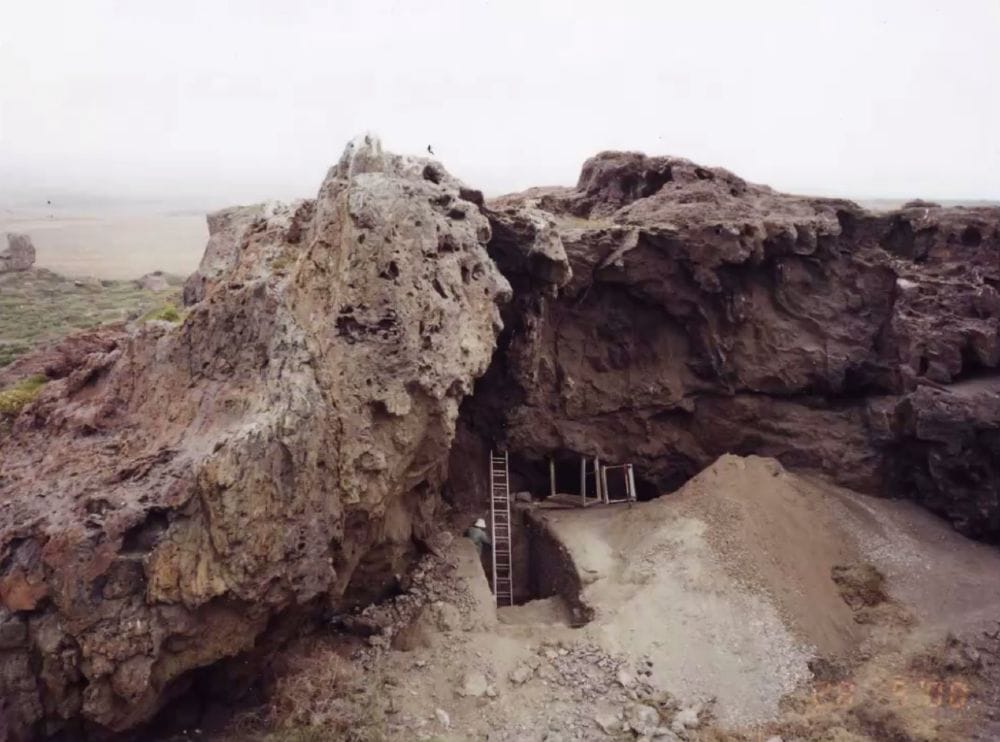
One of many sites studied by the authors, Abrigo de los Escorpiones is a large rock shelter nestled in an ancient volcanic crater in Baja California. The basalt overhang sheltered a midden (or archeological trash heap) documenting over 10,000 years of human occupation, and an even deeper record of the meals of ancient birds of prey. Gruhn and Bryan excavated the site during visits from 2000 to 2004 and published a preliminary report in 2009. The new volume makes detailed information available and summarizes the work of other researchers who built on the early findings.
People throughout prehistory likely occupied the site during rainy seasons to harvest marine resources. The animal remains and cultural artifacts found there are consistent with the Paleocoastal Tradition, a maritime-focused subsistence economy reported on Isla Cedros further south and in the Santa Barbara Channel region to the north—hence the Museum’s interest in publishing this report. The Museum’s Contributions in Anthropology series aims to make available the findings of local archaeological research, and in this case, while the research itself was not local, it has local relevance that the SBMNH Department of Anthropology hopes to bring to light.
A growing number of sites of early human habitation along the Pacific Rim support the possibility that people followed a “kelp highway” to the Americas, drawing on this ecosystem as a dependable food source as they traveled. Sea otter bones found at Abrigo de los Escorpiones suggest an ancient kelp forest offshore at this very site.
Records of California Mussels at the site going back 11,000 years before the present document what may be the longest continuous proxy record of changes in sea surface temperature during this period. Loren Davis, Ph.D., collected samples and studied oxygen and carbon isotopes to track the changes, which concur with other paleoclimate records for the Northern Hemisphere and with the climate trends inferred by studying vertebrate animals found at the site.
Abrigo de los Escorpiones is now available in the Museum Store.
For more information on the Museum’s Department of Anthropology, visit sbnature.org/collections-research/anthropology.
###
About the Santa Barbara Museum of Natural History
Powered by Science. Inspired by Nature. The Santa Barbara Museum of Natural History connects people to nature for the betterment of both, drawing on collections that preserve the natural and cultural heritage of the Central Coast and beyond. Founded in 1916, the Museum is a private nonprofit supported in part by philanthropy, membership, and visitors. Members visit free. For more information, visit sbnature.org.
Leave a Response