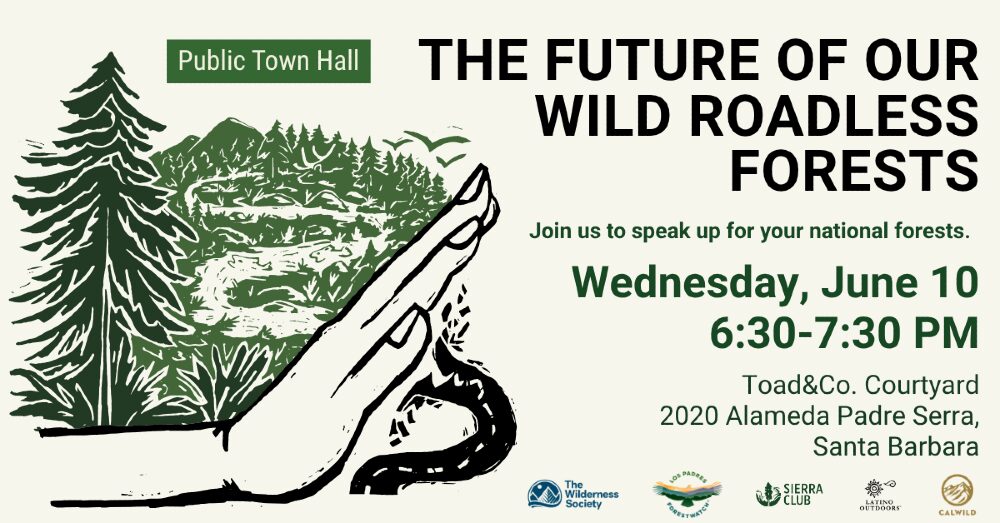
Community members, conservation advocates, and outdoor organizations will gather in Santa Barbara on Tuesday, June 10, for a public town hall focused on proposed federal changes to the Roadless Area Conservation Rule—one of the nation’s most significant protections for backcountry public lands.
Hosted by Los Padres ForestWatch in partnership with Sierra Club, CalWild, Latino Outdoors, The Wilderness Society, and Keep the Sespe Wild, the event take place at Toad&Co and is part of a broader series of community meetings held across California’s Central Coast.
For 25 years, the Roadless Rule has protected millions of acres of national forest lands from new road construction, large-scale logging, and mining. The rule currently safeguards more than 635,000 acres within and surrounding Los Padres National Forest, helping preserve wildlife habitat, clean drinking water, and recreation opportunities throughout the region.
The Trump Administration is proposing to roll back those protections while dramatically limiting public participation in the process. Organizers say the U.S. Forest Service is expected to open a short public comment period—potentially as brief as 15 or 30 days—without holding a single public hearing.
“This is one of the most important forest conservation protections in the country,” said Jeff Kuyper, Executive Director of Los Padres ForestWatch. “The Roadless Rule exists because millions of Americans demanded protections for backcountry forests. The public deserves transparency, public hearings, and a meaningful opportunity to participate.”
First adopted in 2001 following more than 600 public hearings and 1.6 million public comments—the largest public response to a federal rule in U.S. history at the time—the Roadless Rule continues to receive broad bipartisan support. A 2019 national poll found that 75 percent of Americans supported maintaining Roadless Rule protections.
Organizers emphasize that the rule does not prevent public access. Despite the name, roadless areas already contain existing roads and recreation infrastructure, including 349 miles of designated roads and motorized and non-motorized trails within Los Padres National Forest alone.
“This isn’t about closing forests to the public,” said Ben Pitterle. “The Roadless Rule simply prevents new permanent roads and the most intensive forms of logging in some of our most intact backcountry landscapes. Recreation, trail access, and wildfire mitigation projects are already happening in these areas.”
Advocates also point to the growing maintenance backlog on existing forest infrastructure. In 2024, the Forest Service reported a nationwide road maintenance backlog exceeding $5.6 billion.
“The issue isn’t a lack of roads,” Pitterle added. “It’s that we’re struggling to maintain the roads and trails we already have.”
The Santa Barbara town hall is one of four regional events organized to raise awareness ahead of the anticipated public comment period. Previous meetings have already taken place in Ojai and Ventura, with an additional town hall scheduled for June 24 in San Luis Obispo.
Attendees will hear from conservation advocates and organizers about what the proposed rollback could mean for forests, wildlife, watersheds, and recreation access across the Central Coast, as well as ways community members can engage once the public comment process begins. Spanish translation will be provided.
Event Details
What: Santa Barbara Roadless Town Hall
When: Wednesday, June 10 from 6:30-7:30 pm
Where: Toad&Co. Courtyard, 2020 Alameda Padre Serra, Santa Barbara, CA
Learn more: https://forestwatch.org/event/santa-barbara-roadless-town-hall/
Partner Perspectives
“Toad&Co has always been about showing up for the places and communities we care about, and taking care of the planet is core to our ethos. Los Padres National Forest is in our backyard, and we’re proud to open our doors for this conversation. We believe outdoor places only endure when people are informed, engaged, and willing to help protect them.” —Gordon Seabury, CEO of Toad&Co.
“Californians value our wild forests deeply. These wild, roadless landscapes are not just places on a map—they protect the clean water we drink, support the clean air we breathe, and safeguard our freedom to explore and connect with nature. Rolling back the Roadless Rule serves no one but private companies seeking to exploit these wild places and puts all of us at risk of more wildfires.” —Helen O’Shea, California State Director of The Wilderness Society
“Rescission of protections for our country’s last untouched public lands fragments our forests, disrupts wildlife corridors, and weakens our local ecological resilience. The main concern of the Santa Barbara Sierra Club and our allies is that rescission of the Roadless Rule is not an isolated decision but is part of a larger pattern of deregulation that removes environmental protections and opens industrial access. We must speak up in defense of our local resources and communities.” —Emily Engel, Santa Barbara Sierra Club Group Chair
“The Roadless Rule may be the most valuable conservation policy most Americans have never heard of, so we have the challenge of making sure people across the political spectrum understand what’s at stake within a short time frame. The Roadless Rule was built on the recognition that forests aren’t just crops to be harvested, they provide irreplaceable ecosystem services to us at no cost. At a time when we can’t maintain the roads we already have, building new ones into these lands isn’t just bad conservation, it’s bad economics. I have not spoken with a single forest supervisor who thinks rescinding this policy is a good idea.” —Peter Deneen, Executive Director of Keep the Sespe Wild
Leave a Response